How Surface Changes Influence Positioning Tactics in Thoroughbred Racing
Written by Leon Schmid · Jun 9, 2026

How Surface Changes Influence Positioning Tactics in Thoroughbred Racing
Track surfaces in thoroughbred racing create distinct challenges when horses move between turf, dirt, and synthetic materials during a single meeting or across a season, and analysts track these shifts because they alter stride patterns, energy distribution, and preferred racing lines. Data collected at major venues shows that horses which excel on firm turf often lose several lengths when the ground softens or switches to dirt, prompting trainers to adjust starting positions and pace instructions accordingly. Observers note that early identification of these surface preferences allows connections to place runners in lanes that reduce the impact of the change, particularly when rails are moved or watering programs alter moisture levels mid-card.
Core Surface Types and Their Measurable Effects
Dirt tracks compact under repeated traffic and produce kickback that affects vision and balance, whereas turf provides a more consistent cushion yet reacts sharply to rainfall, and synthetic surfaces maintain uniform speed ratings across weather conditions according to reports issued by the North American Association of Racetrack Veterinarians. Studies conducted at the University of Kentucky's Gluck Equine Research Center indicate that stride frequency drops by an average of 4 percent when horses transition from synthetic to turf, while ground reaction forces increase on firmer dirt, leading to earlier fatigue in longer races. Those patterns become especially relevant in June 2026 when several North American circuits schedule mixed-surface programs that force horses to adapt within hours of each other.
Strategic Position Adjustments During Transitions
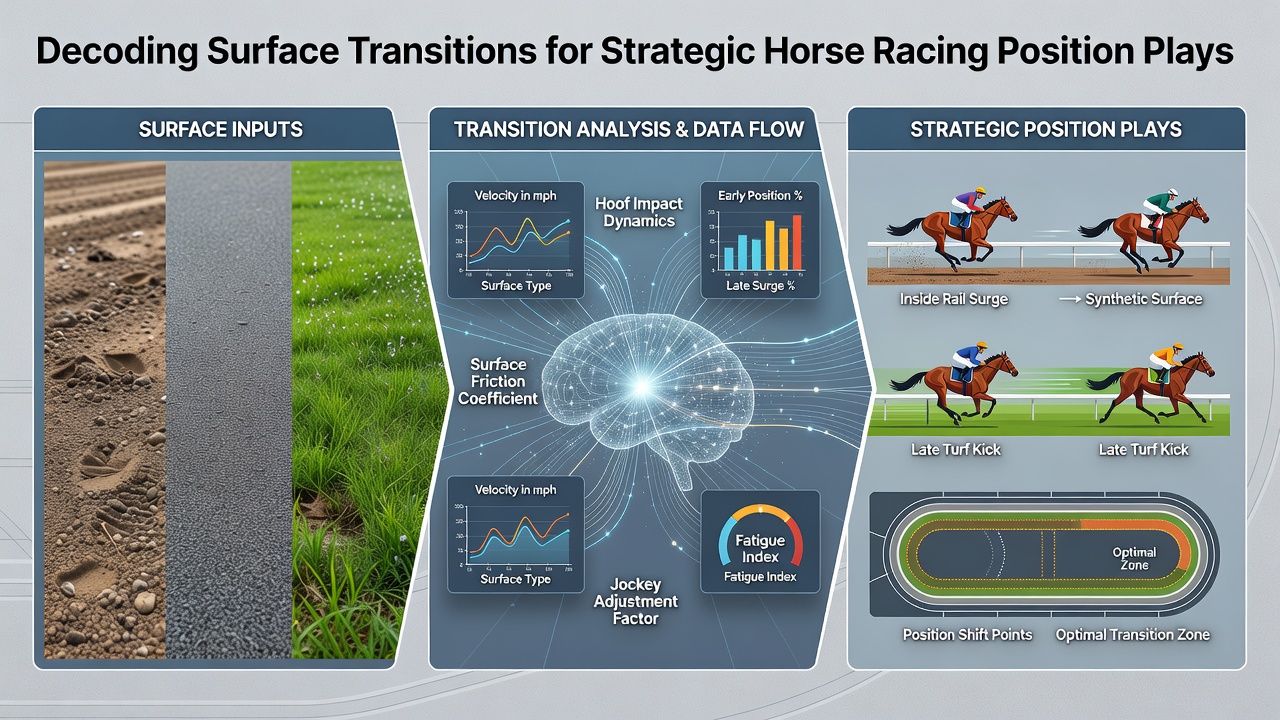
Trainers respond to surface changes by altering post positions and early-race instructions so that horses avoid the deepest going or the most abrasive kickback zones. On a card that moves from turf to dirt, for example, runners drawn inside may be asked to angle outward early to reach fresher ground, while those drawn wide sometimes receive hold-up tactics that conserve energy until the surface firms up in the straight. Racing Australia documentation reveals that horses given such repositioning instructions improve their place rates by roughly 12 percent compared with runners left to their natural tendencies across changing surfaces. The same data set shows that jockeys who study sectional splits from prior races on each surface gain an edge when deciding whether to lead, stalk, or drop in behind during the transition races.
Case Examples from Recent Meetings
Take one three-year-old colt entered at a Midwestern track in early summer 2026 whose previous turf efforts placed him near the rail yet whose dirt form suggested he handled kickback better when allowed to race three or four paths off the inside; connections switched his positioning plan and recorded a career-best speed figure. Another example emerged at a European venue where a mare moving from soft turf to a newly laid synthetic strip was deliberately held up in the early stages, avoiding the deeper inside lane until the surface provided more rebound, resulting in a narrow victory that sectional timing confirmed owed much to the delayed move. Such adjustments illustrate how surface knowledge translates directly into lane selection and pace management rather than relying solely on overall class or distance suitability.
Data Sources That Track Surface Performance
Performance databases maintained by Equibase and Racing Australia compile surface-specific speed figures and running-line comments that allow handicappers to quantify how individual horses respond to transitions, and those figures are updated after every meeting so that patterns emerge quickly. When the same horse records markedly different sectional times on consecutive days with a surface switch, analysts recalculate expected pace scenarios and advise revised positioning tactics for upcoming entries. Research published by the Canadian Pari-Mutuel Agency further demonstrates that synthetic-to-turf transitions produce the largest variance in closing speeds, prompting many trainers to school horses over both surfaces in the weeks before a mixed meeting.
Implementation in Daily Racing Programs
Daily programs now include surface notes alongside traditional past-performance lines, and many racing offices publish expected rail movements and watering schedules in advance so that position decisions can be made before entries close. Trainers review these notes together with video of recent races on each surface, then brief jockeys on whether an inside, middle, or outside path offers the best chance to minimize the effect of the transition. The approach proves particularly useful at tracks that rotate between turf and dirt within the same afternoon, because early races can alter the condition of later surfaces through divots, watering, or sunlight exposure.
Conclusion
Surface transitions remain a measurable variable that influences stride mechanics, energy use, and optimal lane selection across thoroughbred racing worldwide. When connections combine surface-specific data with deliberate positioning plans, horses reach the finish line having expended energy more efficiently on the prevailing ground. Continued collection of sectional and speed-figure information from multiple jurisdictions supports ongoing refinement of these tactics as schedules evolve through 2026 and beyond.