Altitude's Role in Reshaping Clay Court Tennis Betting Markets
Written by Sage Klein · Aug 1, 2026

Altitude's Role in Reshaping Clay Court Tennis Betting Markets
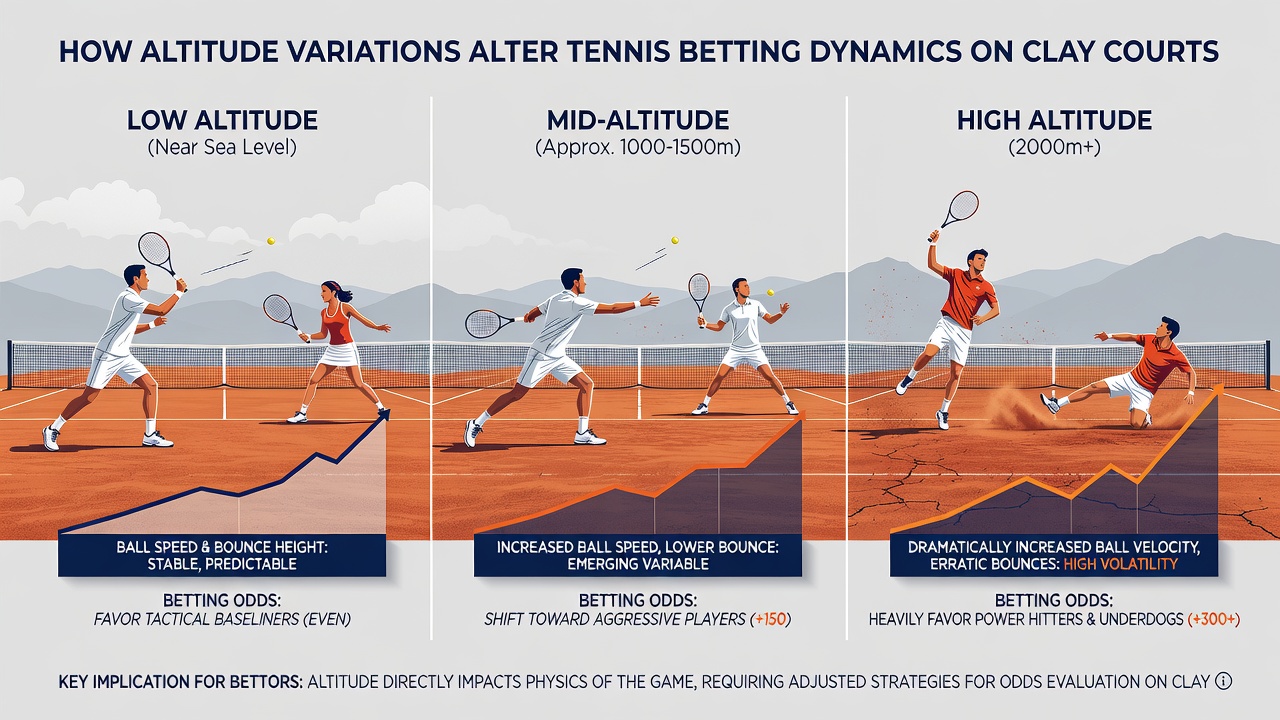
Altitude creates measurable differences in how tennis balls behave on clay courts, and those physical changes directly influence the way betting markets respond to matches played at varying elevations. Researchers have documented that thinner air at higher elevations reduces drag on the ball, which increases its speed even on slower clay surfaces that normally absorb pace and produce higher bounces. Observers note this combination alters rally lengths, point construction, and ultimately the statistical profiles that oddsmakers use to set lines.
Physical Effects of Elevation on Clay Court Play
Clay courts already slow the ball through friction and create topspin-friendly conditions, yet elevation modifies these baseline traits in consistent ways. At sea level the denser atmosphere keeps the ball in check during long exchanges, whereas sites above 1,500 meters allow the ball to travel farther with less resistance. Data collected from professional events shows average rally lengths shorten by roughly 15 percent when matches move from low to high altitude, even though the surface remains clay. Players adjust by flattening shots or adopting more aggressive positioning, patterns that appear repeatedly in match logs from tournaments held in South American and European mountain venues.
Ball bounce also changes because reduced air density lets the ball retain more vertical velocity after impact. Studies conducted by sports science groups in Australia and Canada confirm that clay courts at elevation produce bounces that sit slightly lower and skid more than expected, forcing baseliners to modify footwork and timing. These adaptations surface most clearly during extended baseline rallies, where the margin for error narrows quickly and unforced errors rise in the later sets of best-of-three matches.
Statistical Shifts That Influence Betting Lines
Bookmakers incorporate altitude data when constructing totals and player props because historical records reveal predictable deviations from sea-level norms. Matches played above 2,000 meters post higher combined game counts in opening sets, yet totals compress in deciding sets as fatigue compounds the effects of thinner air. Figures from ATP and WTA events staged in August 2026 at venues such as Bogotá and Quito illustrate this pattern, with over percentages climbing early before settling as players adapt or tire.
Break-point conversion rates also move. Data indicates that servers hold more frequently at altitude because returns travel faster and give returners less reaction time, while clay's sliding surface still allows defensive recovery on some shots. Bettors tracking these metrics adjust their focus toward underdog service-hold props and away from traditional clay-court grinders who rely on extended rallies. Markets respond by tightening spreads and shifting live odds more aggressively after the first set when altitude effects become visible in real time.
Player Adaptation Patterns Across Elevations
Those who compete regularly at multiple elevations develop measurable adjustments in stroke selection and recovery positioning. Players with flatter groundstrokes gain an edge because the ball skids through the court rather than sitting up for heavy topspin opponents. Records from multiple seasons show that athletes from lower-altitude regions post lower win percentages on first visits to high venues, then improve markedly on return trips once they calibrate their timing. This learning curve appears in head-to-head data and influences pre-match odds as oddsmakers factor recent form at similar elevations into their models.
Coaches track heart-rate and recovery metrics during acclimatization periods, and these physiological factors feed into betting models indirectly. When a player arrives with limited preparation time, service percentages dip and double-fault rates climb in the opening matches. Markets price this reality through adjusted totals and live betting volatility, creating windows where informed bettors target specific sets rather than full-match outcomes.
Market Response and Odds Construction
Betting operators integrate altitude-adjusted statistics into their algorithms, drawing on performance databases maintained by organizations such as the International Tennis Federation and academic research from the University of Calgary's sports science program. These inputs produce more nuanced totals and player props than simple surface-based models. Sharp bettors monitor line movements that reflect late adjustments for weather or player travel, because even small changes in barometric pressure can shift expected game counts by one or two per set.
Live betting volumes increase at high-altitude clay events because point-by-point data reveals momentum swings faster than at sea level. When rallies shorten, momentum shifts become more abrupt, and in-play markets widen spreads accordingly. Observers tracking these patterns note that underdog comebacks occur at slightly higher rates once the thinner air accelerates fatigue in favorites who rely on long defensive sequences.
Conclusion
Altitude introduces consistent, quantifiable changes to clay-court dynamics that betting markets incorporate through updated statistical models and real-time adjustments. Physical effects on ball flight and bounce translate directly into altered rally lengths, hold percentages, and set totals, while player adaptation data adds another layer that oddsmakers weigh when setting lines. Those monitoring elevation-specific records and travel schedules gain clearer insight into where value appears across pre-match and live markets at venues operating in August 2026 and beyond.